
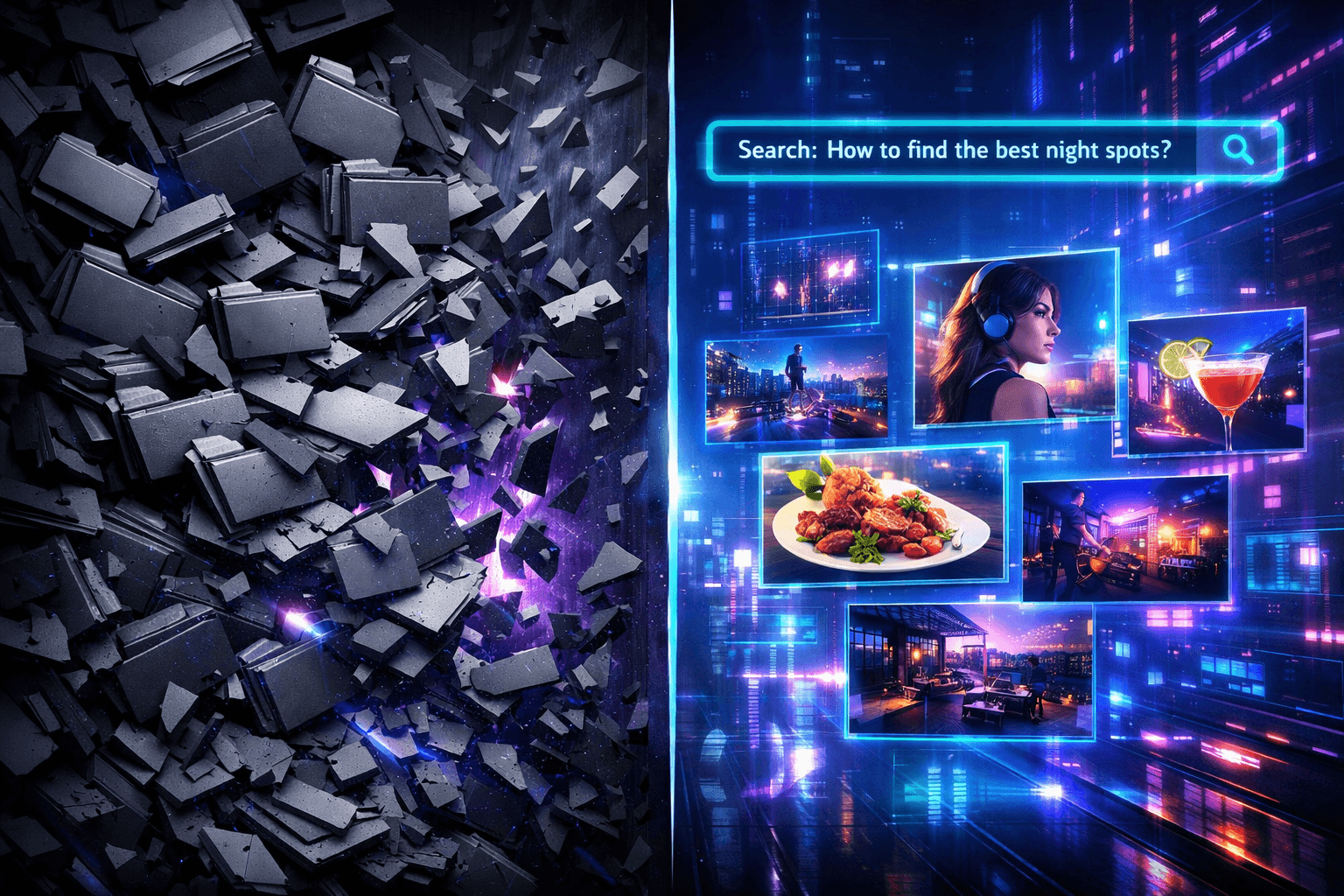
The marketing nightmare: somewhere in your S3 bucket, buried nine folders deep under /2023/Q4/Product_Launch/Raw_Footage/Misc/, is the perfect shot...

The corporate marketing nightmare: somewhere in your S3 bucket, buried seventeen folders deep under /2023/Q4/Product_Launch/Raw_Footage/Misc/, is the perfect shot. You know it exists. You filmed it. But finding it? That's another story.
Welcome to the folder tax—the hidden cost of organizing content the same way we did in 1995. Every minute spent clicking through nested directories is a minute not spent creating. Every "Can you find that file?" Slack message is a reminder that your content infrastructure is working against you, not for you.
The era of file-based workflows is over. Context has won. This conversational approach is transforming media creation.
The Folder Fallacy
Here's the uncomfortable truth: folders were never designed for modern media workflows. They were designed for a world where you had dozens of files, not thousands. Where content was local, not distributed across S3, Box, Google Drive, and that external hard drive someone's holding hostage in the studio closet. This chaos is central to the modern content crisis
The moment you organize content into folders, you make a fundamental choice: this video goes in /Products/ or /Campaigns/ or /Events/. Pick one. Live with it forever. Hope future-you remembers which arbitrary decision past-you made at 4pm on a Friday.
Corporate marketing teams know this pain intimately. You're sitting on terabytes of content—product demos, testimonials, b-roll, event footage, that incredible sunset shot from the conference last year. It's all in S3. It's all "organized." And it's all essentially invisible unless you remember the exact path someone created eighteen months ago.
The folder system demands you predict the future. Will you search for this video by date? By campaign? By product? By the person who shot it? You have to choose one primary taxonomy and pray it matches how people will actually search.
The Tagging Trap
"Just tag everything!" says someone who has never actually tagged everything.
Manual tagging was supposed to solve the folder problem. Add metadata, they said. It'll make everything searchable, they said. And they were right—in theory.
In practice? Manual tagging is where content goes to die.
Here's what actually happens: the first week, everyone diligently tags their uploads. sunset, product_demo, conference_2024. Week two, the tags get lazier. misc, final_FINAL_v3, use_this_one. Week three, people stop tagging altogether because they're on a deadline and who has time for metadata when the CMO wants the video in an hour?
60% untagged content
30% inconsistently tagged content (
SunsetvssunsetvsSUNSETvsgolden_hour)10% properly tagged content that no one can find anyway because the search only works if you remember the exact tag
30% inconsistently tagged content (Sunset vs sunset vs SUNSET vs golden_hour)
10% properly tagged content that no one can find anyway because the search only works if you remember the exact tag
The fundamental problem is that tagging requires human prediction. You have to anticipate what future-you will search for. You have to get everyone on the team to use the same vocabulary. You have to maintain discipline during crunch time.
Humans are terrible at this. AI is exceptional at it.
Enter: Semantic Search
Imagine typing "that shot with the sunset and the dog" and actually finding it. In seconds. No folders to navigate. No tags to remember. Just natural language, like you're talking to a colleague who has photographic memory of your entire content library. This conversational approach is the future of media creation
See how Flo's semantic search transforms content discovery.
This isn't science fiction. This is semantic search—and it's what happens when AI learns to understand the actual content of your media, not just the filename.
Traditional search works like this: you search for "sunset," it looks for the text string "sunset" in filenames and tags. If you named the file IMG_[2847.mp](<http://2847.mp>)4, too bad. If you tagged it but spelled it suset, too bad. If it's the most gorgeous sunset footage ever captured but nobody wrote the word "sunset" anywhere in the metadata, too bad.
Semantic search works like this: AI watches the video. It sees the sunset. It sees the dog. It understands that this is a golden-hour outdoor scene with an animal. It recognizes the emotional tone, the composition, the movement. It indexes all of this—not as tags you typed, but as understanding of what the content actually is.
Now when you search "that shot with the sunset and the dog," the AI doesn't look for those exact words in a database. It understands what you're asking for and matches it against what it actually saw in the content.
Sunset? Check. Dog? Check. Here's your file. Three seconds. No folders. No tags. No archaeology degree required.
Context Over Taxonomy
The shift from folders to semantic search represents something bigger than faster search. It's a fundamental rethinking of how we relate to content.
Affordable AI-powered search for teams of any size.
Folder-based systems are taxonomy-first: organize, then find. You create a structure, force content into it, and hope future searches align with that structure.
Semantic search is context-first: capture, then discover. You upload content. AI understands it. You search when you need it, using whatever language makes sense in that moment.
This is the "Cursor for Media" moment. Cursor transformed coding by letting developers write in natural language and having AI understand intent. You don't organize your code into functions_that_handle_authentication/ and functions_that_process_payments/. You just write what you need, and intelligent tools help you navigate the codebase.
Media should work the same way. You shouldn't organize videos into /corporate_events/2024/Q3/ when you could just upload them and ask "show me all conference footage from this year with our CEO speaking."
Real Scenarios: The New Normal
Old way: Client wants a highlight reel emphasizing innovation and team culture. You spend 2 hours clicking through folders (/Brand/, /Culture/, /Product_Launches/), downloading candidates, scrubbing through footage to find relevant moments.
New way: You search "innovative product moments with team collaboration." AI returns shots that match the semantic meaning—not just literal appearances of those words, but footage that embodies those concepts. You're reviewing candidates in 5 minutes, not 2 hours.
Old way: Someone mentions "that great testimonial from the healthcare client in the blue shirt." You check /Testimonials/. Not there. /Clients/Healthcare/. Not there. /2024_Content/. Not there. You Slack three people. Someone thinks it might be in Box. It's not. It's eventually found in /Misc_Raw/DO_NOT_DELETE/ where someone temporarily stashed it.
New way: You search "healthcare testimonial blue shirt." AI finds it instantly, wherever it lives, because it actually saw the content.
Old way: Legal needs to verify that all footage in the latest product video was properly licensed. You need to track down the original source files for twelve different shots. You spend a day reconstructing the paper trail through project folders, Slack messages, and someone's local editing timeline.
New way: AI already knows the relationship between the final edit and source footage. You ask "show me all source files used in the Q4 product video," and it surfaces everything instantly, including usage metadata.
The Human-in-the-Loop Future
Here's what makes this approach truly powerful: AI does the impossible (understanding millions of frames of video), while humans do the irreplaceable (making creative decisions). See how teams unlock their untapped S3 archives
You don't need to train everyone on folder structures. You don't need tagging meetings. You don't need taxonomy governance committees. You need creators who understand what they're looking for, and AI that understands what you have.
This is the "Human-in-the-Loop" philosophy: AI handles discovery, humans handle decisions. The system surfaces candidates based on semantic understanding, you choose what actually works for your vision.
It's a studio-grade capability—the kind of semantic search that major entertainment companies spent millions building—now available to corporate marketing teams, growing creators, and anyone who's drowning in content they can't find.
The Inevitable Transition
The shift from folders to context isn't about technology fashion. It's about survival. Content velocity is accelerating. Teams are distributed. The volume of media being created has exploded.
Make the switch to context-aware content management.
You cannot folder-hierarchy your way out of a terabyte S3 bucket.
The companies that thrive in the next decade will be those that treat content as semantically searchable from day one. That build workflows around "discover, generate, deliver" rather than "organize, store, hopefully remember where we put it."
This is the death of file-based workflows, and honestly? It's overdue. Folders served us well in the age of a hundred files on a desktop. But in the era of cloud-distributed, AI-native media operations, context beats folders every time.
The future is here: you just describe what you need, and AI understands what you have. No folders. No manual tags. No archaeological expeditions through nested directories.
Just content that's actually findable. Finally.
Ready to escape folder hell? Flo makes your entire S3 and Box content library semantically searchable from day one. Connect your storage, and start searching in natural language. Start Free with 10 hours of Gen AI processing.
‹ From Desktop to Cloud: How YouTube Creators Scale Beyond 100K Subscribers
Why 'Cursor for Media' Is the Future of Content Creation ›
Continue Reading

Corporate Marketing's Secret Weapon: Your Untapped S3 Archive
This article provides a brief overview of the key ideas, insights, and takeaways covered in the post. Whether you're here to explore trends.
Corporate Marketing's Secret Weapon: Your Untapped S3 Archive
From Desktop to Cloud: How YouTube Creators Scale Beyond 100K Subscribers
From Desktop to Cloud: How YouTube Creators Scale Beyond 100K Subscribers
The Death of File-Based Workflows: Why Context Beats Folders
The Death of File-Based Workflows: Why Context Beats Folders
Corporate Marketing's Secret Weapon: Your Untapped S3 Archive
From Desktop to Cloud: How YouTube Creators Scale Beyond 100K Subscribers