
Human-in-the-Loop: Why AI Agents Need Approval Workflows
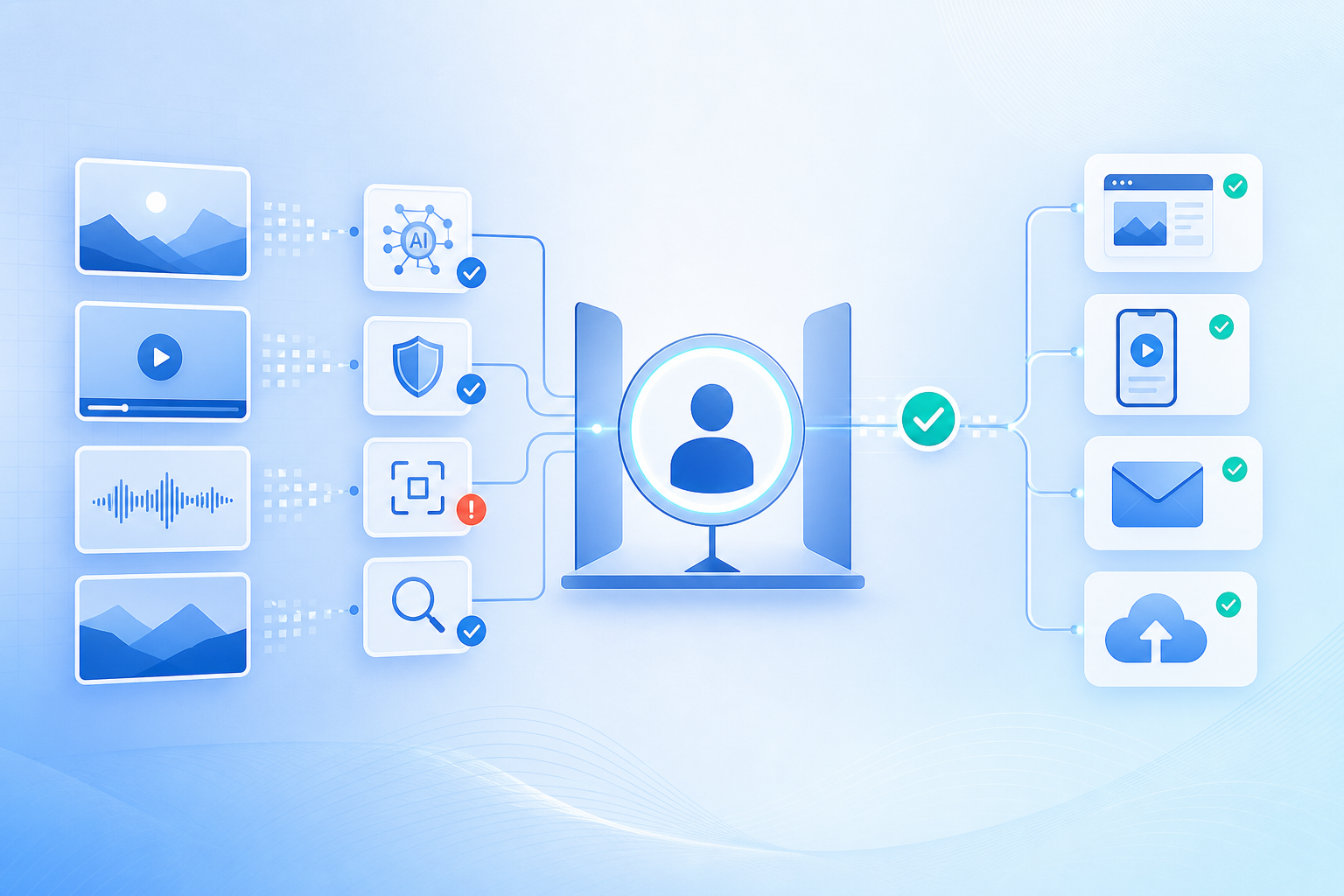
Your team just ran an AI workflow across 200 campaign assets. Brand compliance checks: complete. Sensitive content flags: surfaced. Highlight reels: assembled. Transforms: rendered.
Now imagine every one of those outputs publishing automatically—with no reviewer, no audit trail, no one accountable when the old logo hits the homepage at 3 AM.
No responsible marketing leader wants that world.
And no serious AI vendor should pretend that’s the goal.
The future of media automation isn’t “AI replaces your team.” It’s AI accelerates your team—with humans in the loop where judgment, accountability, and brand stakes require it.
The Trust Gap Holding Back AI Adoption
Corporate marketing and studio ops teams aren’t slow to adopt AI because they don’t see the value. They’re cautious because the cost of being wrong is asymmetric.
A missed B-roll shot wastes an afternoon. A wrong logo in a global launch wastes reputation, legal hours, and executive trust.
Gartner and industry analysts keep warning the same story: agentic AI projects fail when organizations chase automation without governance, integration, and clear accountability. “Agent washing”—slapping autonomy on a feature list—doesn’t survive contact with a brand guidelines PDF or a regional compliance officer.
So buyers ask the right questions:
- Who approved this?
- What did they see when they approved it?
- Can we prove it for audit?
- What happens when AI flags something ambiguous?
If your answer is “we’ll check it in Slack after it goes live,” you don’t have a workflow. You have a liability.
What Human-in-the-Loop Actually Means
Human-in-the-loop (HITL) is not “humans do everything, AI suggests sometimes.”
It’s a deliberate split of labor:
| AI agents excel at | Humans must own |
|---|---|
| Searching millions of frames in seconds | Creative and strategic fit |
| Running consistent QC rules at scale | Ambiguous brand judgment calls |
| Assembling drafts and variants | Final approval to publish |
| Surfacing rights and compliance flags | Legal interpretation and exceptions |
| Executing repetitive transforms | Escalations when context is novel |
AI proposes and prepares. Humans decide and approve.
That distinction is the difference between a demo that wows in a conference room and a system that survives your first global campaign.
Why “Fully Autonomous” Is the Wrong North Star
There’s a seductive pitch in 2026: “Our agents run your entire pipeline—no humans required.”
For some low-stakes batch jobs, autonomy makes sense. For brand-facing marketing and regulated media, it’s a category error.
Autonomy without approval is speed without accountability.
Consider what actually goes wrong when automation runs unchecked:
- Brand drift: AI selects a clip that’s technically on-brand but tonally wrong for the moment
- Rights edge cases: Metadata says “cleared” but usage context changed
- Regional sensitivity: Imagery acceptable in one market, problematic in another—flagged statistically, not culturally
- Technical false positives: QC rejects a valid creative choice because rules were over-fitted
- Version chaos: “Approved” happens in email; published asset is a different export
Every one of these is fixable if approval is part of the system, not an afterthought in someone’s inbox.
Major studios learned this decades ago: automation in the pipeline, humans at the gate. Corporate marketing deserves the same architecture—without the six-figure MAM team to operate it.
Approval Workflows Are the Trust Layer
An Agentic Media Platform doesn’t end at “AI did a thing.” It ends at “the right person signed off, and we can prove it.”
That requires workflow primitives enterprises expect—but rarely get from point tools:
1. Task-based review in context
Reviewers see the asset, the AI findings, and the proposed action in one place—not a download link and a prayer. Comments attach to the moment they refer to. No “which version did you mean?”
2. Role-based routing
Brand reviews brand. Legal reviews rights. Regional lead reviews localization. Parallel or sequential—your governance model, encoded once.
3. Clear states: draft → in review → approved → delivered
Not ambiguous folders. Not Slack reactions as sign-off. States machines your ops team can report on.
4. Audit trail
Who approved what, when, on which version—with AI QC results attached. When questions come at 3 AM, you answer with data.
5. Block delivery until approval
The workflow doesn’t “suggest” holding publish. Unapproved assets don’t ship. Period.
This is the layer that lets CMOs sleep—and lets technical evaluators say yes without betting their job on a black box.
A Real Workflow: QC + Approval Before Delivery
Here’s how HITL fits the Discover → Generate → Deliver lifecycle on Flo:
Discover. Team finds source footage via semantic search—“product demo, no people, last 12 months.” AI surfaces candidates; human picks the story.
Generate. Transformations run: aspect ratios, captions, clips, brand-safe crops. AI executes; human directs intent via natural language—Cursor for Media style.
Check. Automated QC agents run: logo/version compliance, technical spec, sensitive content signals, rights metadata. Issues attach to the asset as structured findings—not a PDF report someone might not read.
Approve. Brand lead gets a task: two variants pass, one flagged for old logo treatment. They approve A and B, reject C with a note. AI may suggest a logo swap; human confirms before re-queue.
Deliver. Only approved variants route to YouTube, ad platforms, or regional folders. Audit log records the chain.
Total tools where context was lost: zero.
That’s HITL as infrastructure—not a disclaimer in the footer.
Where AI Should Stop (On Purpose)
The strongest enterprise demos aren’t the ones where AI does the most. They’re the ones where boundaries are credible.
Stop before irreversible external publish. Always.
Stop on low-confidence QC. Surface to human; don’t auto-reject or auto-approve blindly.
Stop on rights ambiguity. Flag for legal; don’t guess jurisdiction.
Stop on generative fixes that change meaning. Logo replacement? Maybe—with review. Dialogue alteration? Almost certainly human-gated.
Stop when the brief is novel. AI handles pattern volume; humans handle “we’ve never done it this way before.”
Nielsen’s marketing ops evaluation (May 2026) echoed what we hear everywhere: teams don’t need more AI tricks—they need fewer places where people are the integration layer between tools, tickets, and assets. Approval workflows are how you remove chaos without removing judgment.
HITL vs. Human Bottleneck
Skeptics confuse HITL with “adding another approval meeting.” Done wrong, it is.
Done right, HITL removes bottlenecks:
- AI eliminates the hours of hunting and assembly before review happens
- QC automation means humans review exceptions, not every frame
- In-context approval means no re-export/re-upload cycles to “get it into the system”
- Parallel routing means brand and legal aren’t serial blockers on each other
The goal isn’t more human touches. It’s fewer, higher-leverage human touches—at the moment that actually reduces risk.
If your approval step still requires downloading, emailing, and versioning in filenames, you haven’t built HITL. You’ve built manual process with AI upstream. That still collapses at scale.
Enterprise Proof, Self-Serve Discipline
Warner Bros Discovery, ITV, Paramount+, and other operators run mission-critical workflows on Flo because reliability and governance scale together—not because someone vibe-coded a script over a weekend.
The same pattern applies to corporate marketing:
- Enterprise credibility: Workflows trusted where failure is expensive
- Self-serve access: Teams start without a twelve-month integration project
- Human judgment preserved: Approvals where your brand book says they belong
You can’t vibe-code a media pipeline that legal trusts. You can configure an AMP with approval gates your compliance team recognizes—and iterate in weeks, not years.
How to Evaluate Any “Agentic” Media Tool
Ask vendors:
- Can I enforce approval before delivery—or is export manual?
- Is the audit trail native—or exported from logs?
- Do reviewers see AI findings in context—or in a separate dashboard?
- Can I model roles and routing—or is it one shared inbox?
- What happens on ambiguous QC? Auto-fail? Auto-pass? Escalate?
If the answers are fuzzy, you’re buying automation theater—not operations software.
Speed and Safety Aren’t Opposites
The teams winning in 2026 aren’t choosing between fast and safe. They’re building pipelines where AI makes safe faster:
- Search in seconds, not days
- QC at scale, not spot-check roulette
- Approval in workflow, not in email archaeology
- Delivery gated on proof, not on hope
That’s human-in-the-loop—not as a compromise, but as the architecture that makes agentic media deployable.
Your marketers shouldn’t be the integration layer between AI output and what the world sees.
Flo is—with approval workflows built in, not bolted on.