
The DAM Era Is Over: What an Agentic Media Platform Actually Is
Your marketing team has a DAM (Digital Asset Management system). Maybe two. Files are stored. Permissions are set. Uploads work. Search… works if someone tagged it correctly six months ago on a Friday afternoon.
And yet every campaign still feels like chaos.
The VP asks for a cutdown by Thursday. Legal needs to verify rights. Brand wants the new logo, not the one from 2022. Someone on Slack is still looking for “that factory B-roll from the investor day—maybe 2023?” Your DAM has the file. Your team does not have the hour.
What DAMs Were Built to Solve (And Why That’s Not Enough)
Digital Asset Management systems emerged to answer a real question: Where does our stuff live, and who can access it?
For a world of hundreds of assets on local servers, that was revolutionary. Store it. Find it (if tagged). Share it. The problem was largely storage and retrieval.
That problem is mostly solved. S3, Box, Google Drive, and modern DAMs all handle it. Your corporate marketing team is not failing because files lack a home. You’re failing because home is not the workflow.
A DAM is a repository. Repositories don’t:
-
Understand what’s in a video without manual metadata
-
Transform a hero asset into six platform formats overnight
-
Route content through brand QC before it ships
-
Connect Jira tickets, Salesforce briefs, and approval chains to the actual media
-
Deliver finished assets to YouTube, ad platforms, and regional teams with audit trails
When your team becomes the glue between the DAM, the editor, the QC spreadsheet, the rights log, and the distribution checklist—you are not using a system. You are the system.
Enter the Agentic Media Platform (AMP)
Flo is an Agentic Media Platform—AMP for short. Not a DAM with AI sprinkled on top. Not a single-purpose AI tool that does search brilliantly and stops there.
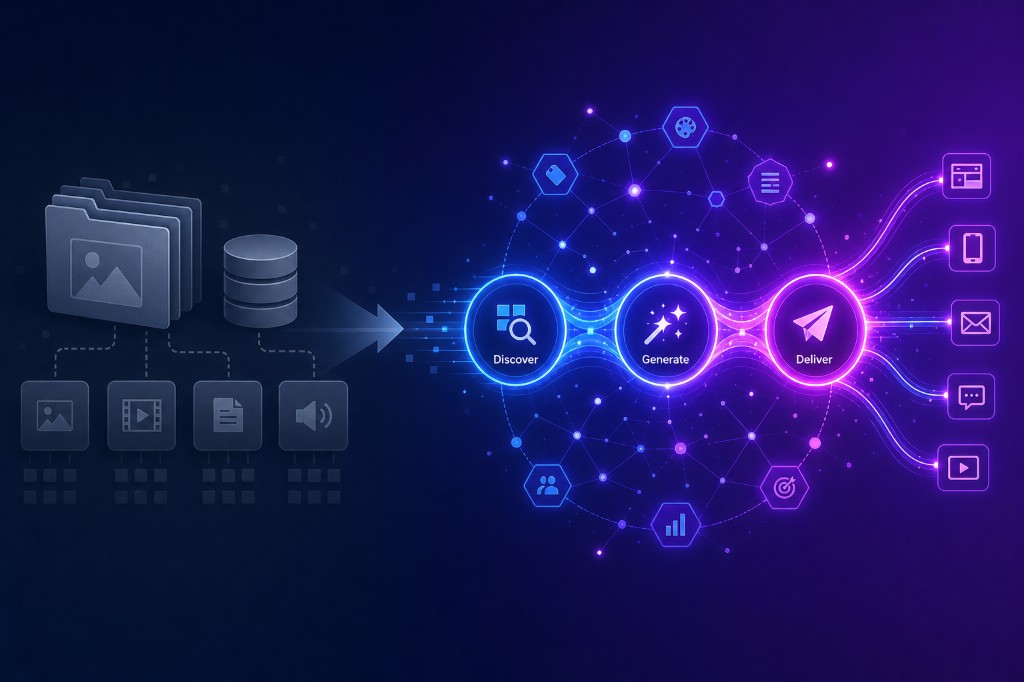
An AMP runs the full media lifecycle in one place, with context that flows between every stage:
Discover — Semantic search across S3, Box, and connected storage. Find footage by what it shows, what it says, and what it means—not by folder archaeology. See why context beats folders.
Generate — 500+ AI-powered transformations through a conversational interface: resize, transcode, localize, clip, fix, enhance. The same “Cursor for Media” principle that made coding intent-driven now applies to your library.
Deliver — Workflows that automate distribution, format adaptation, and handoff—without your team manually exporting, renaming, and re-uploading across six tools.
DAM Today. AMP Tomorrow.
                ****
****| DAM era | AMP era | |
|---|---|---|
| Core job | Store, permission, retrieve | Ingest → understand → route → review → deliver |
| Search | Tags and filenames | Natural language + semantic understanding |
| Editing | Export to another tool | In-context transformation and chat |
| QC | Manual review or separate system | Automated checks + human approval in one flow |
| Context | Lost at every handoff | Shared across the full lifecycle |
| Who integrates the stack? | Your team | The platform |
Why “Best-of-Breed” Is Breaking Your Team
The last decade’s playbook was simple: buy the best search tool, the best editor, the best DAM, the best transcoder, the best review platform. Integrate with APIs. Hire someone to maintain the glue.
It worked when content volume was lower and timelines were longer. It collapses when:
-
Marketing produces 5x more content with the same headcount (the content crisis is real)
-
Every piece needs multiple formats for social, web, paid, and internal channels
-
Global compliance turns one master into dozens of governed variants
-
AI vendors ship powerful point solutions—search here, clips there—that don’t talk to your delivery pipeline
Ten best-of-breed tools means ten places context dies. Ten logins. Ten places something can be “final_v3_ACTUALLY_final.” Ten reasons your marketer is the integration layer.
An AMP doesn’t ask you to rip out storage. Your files stay in S3 and Box. It asks you to stop pretending that storage plus ten satellites equals a workflow.
Agentic Doesn’t Mean “AI Replaces Your Team”
“Agentic” gets abused in 2026. Every vendor claims agents. Many mean chatbots with extra steps.
Here’s what we mean: AI Agents handles repeatable execution; humans retain judgment where it matters.
-
Agents find candidates across your library in seconds
-
Agents run brand, technical, and rights checks at scale
-
Agents assemble drafts, variants, and string-outs
-
Humans approve what ships—brand leads, legal, regional reviewers
Models are infrastructure—they’re getting easier to source from Bedrock, cloud APIs, and specialized providers. What’s not commoditized is the workflow layer: the orchestration, guardrails, audit trail, and handoffs that let enterprises trust automation.
Major studio operators don’t trust duct-tape pipelines. They trust systems where speed and governance coexist. That’s AMP—not vibe-coded scripts between twelve SaaS tabs.
How AMP Differs from “AI Features on a DAM”
Legacy vendors are bolting AI onto existing products: auto-tagging here, smart crop there. Helpful—but still trapped inside command-based, repository-first design.
An AMP is AI-native at the workflow layer:
-
Natural language isn’t a search box add-on; it’s how you direct discovery and transformation
-
Workflows aren’t Zapier chains duct-taped to uploads; they’re media-aware routes with QC and approval built in
-
Context isn’t re-entered at each step; the system remembers what was found, changed, flagged, and approved
Frame.io plus AI search covers review and discovery for production teams. Creative ops platforms organize and resize. Transcoders transform bits. None of them own Discover → Generate → Deliver as one continuous story.
What This Looks Like in Practice
Monday, 9:00 AM. Campaign lead: “Show me all product demo footage from the last 18 months with no people in frame—horizontal preferred.”
Your AMP surfaces matches in seconds from terabytes of existing content. No reshoot scheduled. Your archive stops being a graveyard.
Monday, 10:30 AM. “Create nine-by-sixteen cuts of the top three clips, burn in captions, run brand QC.”
Transformations and automated checks run in workflow—not in a separate tool export loop.
Monday, 2:00 PM. Brand lead gets an approval task in context. Approves two variants, flags one logo issue. AI suggests a fix; human confirms.
Monday, 4:00 PM. Approved assets route to delivery targets. Audit trail captured. No “which version did legal see?”
Total tools opened: one. Total times someone re-downloaded a “final” from email: zero.
Who AMP Is For
Corporate marketing teams sitting on years of campaign footage, drowning in tool sprawl, measured on speed and brand safety—not on becoming expert MAM (Media Asset Management) administrators.
Growing creators and studio teams who’ve outgrown desktop workflows but can’t afford eighteen-month custom builds and six-figure QC stacks. Studio-grade QC without the studio budget isn’t a tagline—it’s the point of AMP.
Enterprise media ops who need connector ecosystems (Jira, rights systems, distribution endpoints) without hiring a permanent integration team.
The Question to Ask Your Stack
In your next martech review, don’t ask only “Do we have a DAM?”
Ask:
-
Can we find anything in our library in natural language—without perfect tags?
-
Can we transform and repurpose without round-tripping through agencies for every variant?
-
Can we QC and approve with auditability—not hope and Slack threads?
-
Can we deliver without someone manually shepherding every export?
-
Does context persist across those steps—or does our team re-create it every time?
Less Repository. More Flow.
The DAM era solved where files live.
The AMP era solves how work gets done—with AI speed and human judgment wired together.
Your marketing team shouldn’t be the integration layer between your tools.
Flo is.
See an Agentic Media Platform on your content
Connect S3 or Box in minutes, search in natural language, and run your first workflow. Start Free 14-Day Trial
Related reading:
-
The Death of File-Based Workflows: Why Context Beats Folders
-
MediaLake in a Box: Why Teams Evaluating MediaLake on AWS Should Try Flo First
Related Articles
[Why ‘Cursor for Media’ Is the Future of Content Creation
                ](/blog/cursor-for-media/)
                [
The Death of File-Based Workflows: Why Context Beats Folders
                ](/blog/file-based-workflows-why-context-beats-folders/)
                [
The Content Crisis: More Content, Harder Success
](/blog/the-content-crisis-we-are-creating-5x-more-content-but-success-is-harder/)