
Media Lake on AWS: Why Teams Should Try Flo First
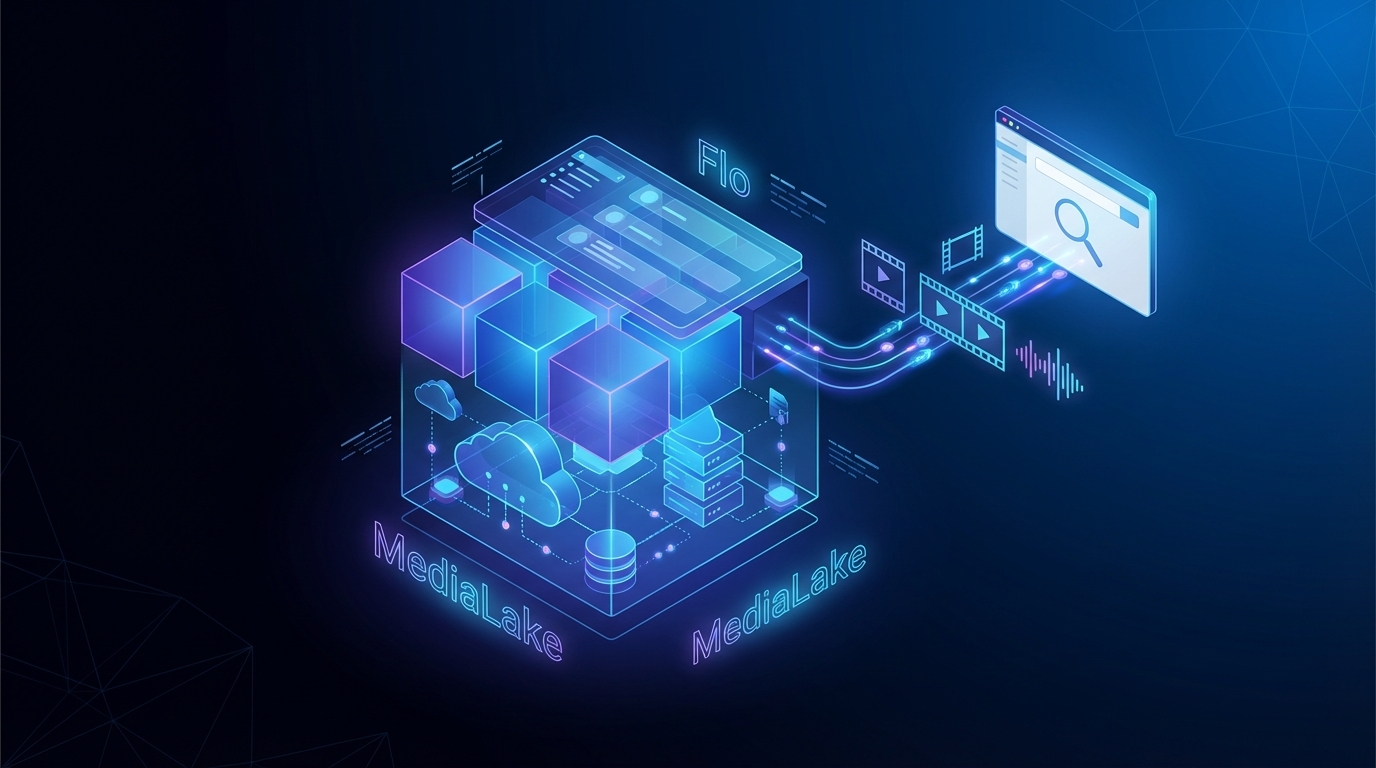
If you’re evaluating Media Lake on AWS, you’re already asking the right questions: how do we modernize our media supply chain so we can move faster, monetize more of our library, and stop drowning in operational complexity?
Media Lake on AWS is a strong answer to that “foundation” problem. It’s a blueprint for a modern media data lake: centralized storage, a standard way to represent media assets and metadata, and a path to connect AI services, analytics, and downstream distribution workflows.
But here’s the catch: most teams discover mid‑evaluation that a powerful foundation doesn’t automatically become a working system.
To turn Media Lake into something your producers, schedulers, ops teams, and engineers can actually use day to day, you still need to assemble an application layer, connect tools, orchestrate workflows, manage governance, and keep cloud costs predictable. That “last mile” is often where timelines slip and proofs of concept stall.
Flo is built for that last mile.
The business goals that push teams toward Media Lake
Media organizations aren’t chasing modernization for its own sake. The drivers are concrete, urgent, and usually tied to revenue:
-
Launch a new FAST channel in days, not quarters, by curating from decades of archived programming.
-
Find every clip featuring a specific actor, brand, or location to unlock new sponsorship or licensing opportunities.
-
Turn a single master into dozens of platform-ready social cutdowns with AI-generated metadata, captions, and compliance checks.
-
Create consistent, searchable metadata across a fragmented archive so teams can reuse content rather than recreate it.
What Media Lake does well: the foundation
Media Lake on AWS is compelling because it addresses a set of hard problems that legacy MAMs and patchwork storage systems struggle with:
-
A centralized, durable repository for media objects (video, audio, images, documents).
-
A standardized data model and metadata approach that reduces silos.
-
A governance and security posture aligned with AWS best practices.
-
A natural integration path to AI services, eventing, analytics, and partner tooling.
What Media Lake doesn’t deliver out of the box: a production-ready system
Media Lake is a blueprint. It’s not a full end-to-end product experience.
That means if you go the DIY route, you typically still need to build or stitch together:
-
Ingest and egress pipelines for real-world volumes and formats
-
Workflow orchestration (what happens when an asset arrives? what triggers transcodes? where do QC results go?)
-
Customizations to the user interface for search, preview, metadata edits, review, approvals, and packaging requests
-
Integrations with best-of-breed tools across QC, watermarking, captioning, packaging, ad markers, etc.
-
Cost controls and operational governance to prevent “cloud bill shock”
This is where many evaluations get expensive.
The DIY evaluation trap
A common pattern we see:
-
A team decides to evaluate Media Lake.
-
They build a proof of concept focusing on storage and a basic catalog.
-
Then they realize they need workflow logic, a UI, integrations, and guardrails.
-
The evaluation expands into a software development program.
-
Time-to-value stretches from weeks into months.
This is nobody’s fault. It’s simply the nature of building a media workflow platform from foundational cloud services.
Flo’s approach: a production-ready implementation of Media Lake
Flo is designed to help teams adopt the Media Lake architecture without getting stuck implementing it.
Flo sits on top of Media Lake on AWS and provides the working system layer: the product experience, workflow orchestration, and operational controls that turn a foundation into something production-ready.
Think of it as two layers working together:
-
Media Lake: the scalable, governed foundation for your media + metadata
-
Flo: the “do stuff” layer that makes Media Lake real in daily operations
“Media Lake in a box”: what that means in practice
When we say Flo is “Media Lake in a box,” we mean your team can start learning and proving outcomes without first having to configure everything from scratch.
1) Faster time-to-value
Instead of spending months assembling the components, you can begin onboarding content and testing workflows immediately.
If your evaluation question is “can we launch FAST channels faster?” or “can we automate cutdowns and metadata enrichment?”, you want to spend your time answering that, not writing glue code and debugging permissions.
2) A product experience your teams can actually use
Foundational architectures don’t come with a user interface that works for producers, librarians, schedulers, and operations teams.
Flo provides a modern interface for discovery, preview, and action — so the evaluation isn’t limited to engineers. The people who work within the workflow can also validate it.
3) Workflow orchestration built for media realities
Media supply chains aren’t linear. They involve branching paths, exceptions, approvals, versions, and deliverables.
Flo provides orchestration so you can define what happens when:
-
Content is ingested
-
Metadata is enriched
-
Quality Control runs
-
Captions are generated
-
Packaging targets are requested
-
Distribution events occur
And it does this while preserving the Media Lake foundation underneath.
4) Predictable operations and cost governance
Cloud is powerful, but an unmanaged cloud is unpredictable.
Flo is built to make operations more predictable with guardrails, best practices, and patterns that prevent teams from discovering cost problems after launch.
5) AWS-expert architecture without hiring an army
Implementing Media Lake well requires the intersection of AWS expertise and media domain expertise.
Flo packages that expertise into a solution so you don’t have to staff a bespoke team just to get a usable first version. Flo is designed and run by former AWS Principal Solution Architects for Media and Entertainment.
Ready to accelerate your Media Lake evaluation?
See how Flo gives you the benefits of Media Lake architecture with a production-ready workflow platform. Start Free Trial
What you can evaluate with Flo (that DIY usually can’t, quickly)
If you test Media Lake on its own, the evaluation often remains tied to the infrastructure’s capabilities.
With Flo, you can test actual outcomes:
-
Can our teams find content faster with consistent metadata?
-
Can we automatically identify footage featuring a specific actor, brand, or subject?
-
Can we run enrichment, QC, captions, and packaging as repeatable workflows?
-
Can we reduce manual steps for social cutdowns and distribution variants?
-
Can we quickly stand up a new FAST channel content pipeline?
A practical way to think about the decision
If you’re evaluating Media Lake, you’re at a crossroads:
-
DIY approach: You validate the foundation, but you still need to build a production-ready product on top of it.
-
Flo approach: You validate the foundation and the product layer together because Flo is already built on top of Media Lake.
Both paths can lead to a successful modern architecture.
The difference is speed, risk, and what you’re actually evaluating.
If your organization has the appetite to build a multi-year platform program, DIY can make sense.
The bigger idea: stop reinventing the media workflow platform
Most media teams don’t want to build a platform.
They want to:
-
Monetize more of what they already own
-
Ship to more channels
-
Improve content reuse and reduce duplication
-
Build a pipeline that scales as content volume and distribution demands explode
Media Lake gives you the right architectural direction.
If you’re thinking about implementing Media Lake, try Flo
If you’re considering Media Lake on AWS, don’t treat your evaluation as a lengthy configuration exercise.
Try Flo as your shortest path to a real, usable Media Lake-powered workflow. Media Lake in a box, ready to run.
You’ll get the benefits of Media Lake plus the benefits of a complete solution: a workflow engine, a user experience, integrations, governance patterns, and a system designed by AWS experts.
The result is a faster evaluation, a clearer business case, and a faster path from “architecture” to “operational advantage.”
Get started with Media Lake in a box
Skip the infrastructure work and start validating business outcomes today. Try Flo Free
Related Articles
[Why Context Beats Folders in Media Management
                ](/blog/file-based-workflows-why-context-beats-folders/)
                [
The Content Crisis: More Content, Harder Success
                ](/blog/the-content-crisis-we-are-creating-5x-more-content-but-success-is-harder/)
                [
How AI is Changing Content Repurposing
](/blog/the-10-minute-highlight-reel-how-ai-is-changing-content-repurposing/)