
Swappable models need open interfaces
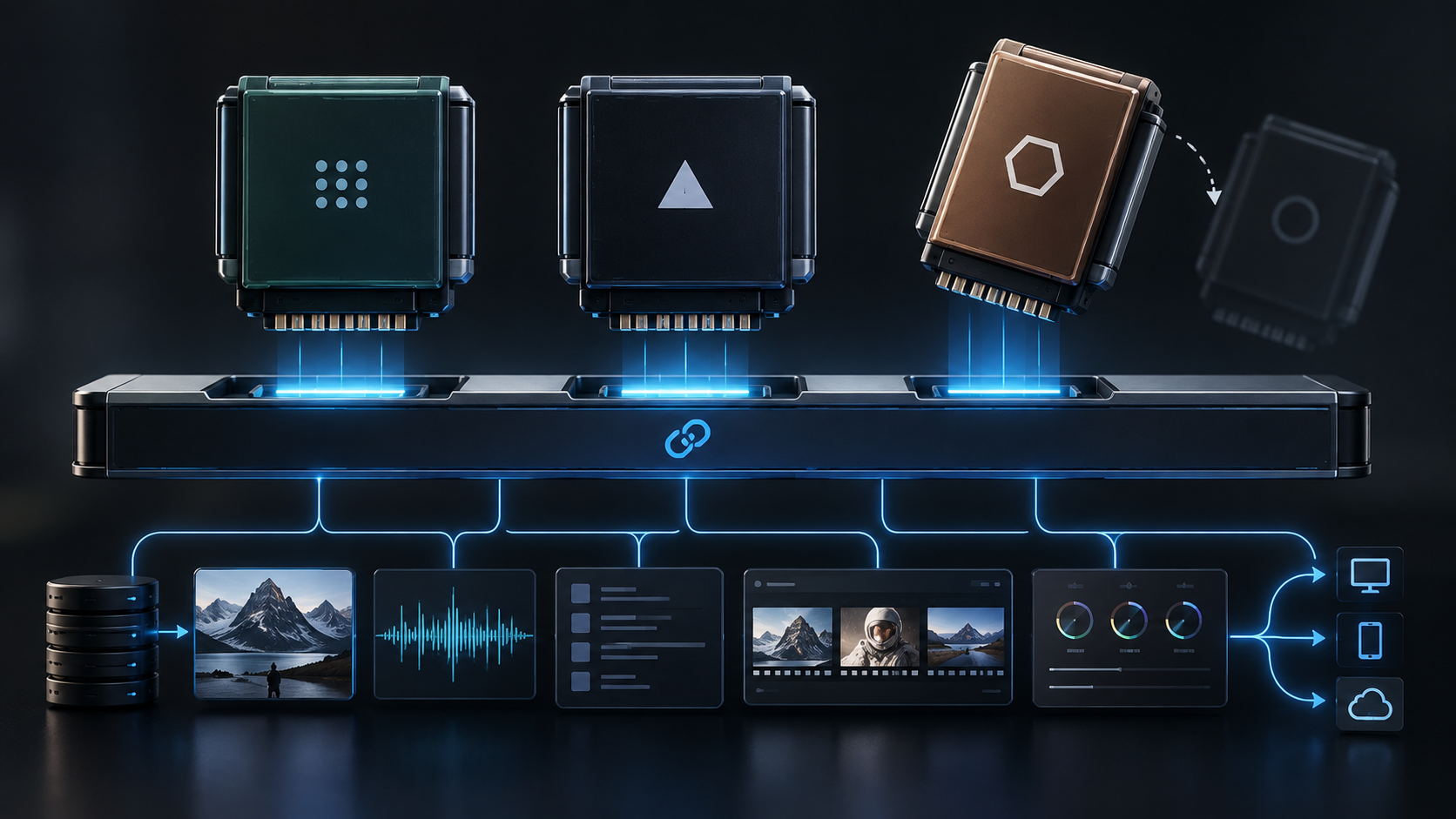
I was catching up on my favorite podcast, All-In, over the weekend. The episode was Anthropic’s Digital God, Pope vs AI, Job Loss Narrative Flips, Open Source Crackdown Coming?, with Bill Gurley filling in. It was released on May 29. Near the end of a segment on AI sovereignty, Gurley relayed an argument he credited to people in the open-source community.1
Any surface where a model touches other software is a connector, and every connector you open source and commoditize makes the model sitting above it easier to replace. He pointed at MCP, which lives under the Linux Foundation, and reached for Kubernetes as the precedent: Google backed an open orchestration layer partly so that workloads could move off a single cloud. Build enough of those interfaces and the models become swappable. He finished by telling founders and developers to go build them and put them in the open.
A little over three months on, the connector half of that argument has gone further than I expected and the policy half has gone somewhere stranger.
The connector layer moved
Anthropic donated MCP to the Agentic AI Foundation, a directed fund under the Linux Foundation, in December 2025, and by late February the foundation counted 146 members. Then on July 28 the protocol shipped a revision that pulled session state out of the protocol core, so an MCP server can now sit behind an ordinary load balancer like any other web service. It arrived with Tier-1 SDK support in TypeScript, Python, Go and C#, and with supporting statements from Google, AWS, Cloudflare and Microsoft. If you run a media library instead of a platform team that reads like somebody else’s release note, but a connector standard with that much of the industry actively shipping against it is now infrastructure that other things get built on.
Gurley’s Kubernetes comparison wasn’t decoration. His May essay, From Open Source Software to Open Source Strategy, traces the same supplier-power logic across several industries before applying it to AI, including the difference between open weights and a genuinely open training stack. The mechanism is the same each time. Once the exchange layer is standardized and cheap, the suppliers above it can no longer price the difficulty of leaving into the contract.
The media version of the problem
Developers already live in the world Gurley described. Route between models inside an IDE or an agent runtime, and what defines the work is the harness rather than any single vendor’s weights. Media has the same shape and much worse physics. A code repository is text, and a team leaving one platform for another is mostly moving text around. A media library is terabytes of masters and proxies, codecs that only some tools handle correctly, contracts that constrain what you are allowed to do with a given asset, and regional variants that exist because a compliance team asked for them three years ago. When one platform holds the files and the model and the workflow graph, changing your mind becomes a migration project with a risk register.
So the interface Gurley wants to open up, in our world, runs from ingest all the way through to delivery. It covers storage, transcode, rights, review, distribution and ticketing, which is a considerably larger surface than an API key.
How we’ve built Flo
We describe Flo as Cursor for media, meaning a place to work in natural language across discovery, transformation, review and delivery. That has never meant asking anyone to replace the tools they already run. Customers connect the storage and systems they already have, which today includes Amazon S3, Box, Google Drive, Airtable and Salesforce, and Flo runs agentic media workflows and search across that connected storage without a migration coming first.
Configured pipeline outputs write back to customer-owned S3. Workflows are versioned and redeployable, and each model step inside one can call a different model, chosen on cost, quality, latency or policy. As models specialize, that routing gets more useful over time, and if models do commoditize the way Gurley expects, the routing simply follows price or speed. The principle underneath all of it is that no single model vendor and no single storage vendor should be load-bearing when a standard connector can do the job.
Anthropic and the threshold argument
The other half of that May episode was about regulation. The segment title on the listing asked whether an open source crackdown was coming, and at the time I thought the risk was that rules would get written so that only a handful of frontier providers could certify a model as safe for production use.
So far that hasn’t happened, at least not under that name. On July 27 Dario Amodei published Anthropic’s position on open weights: the company “has never advocated for a ban on open-weights models,” and open models without dangerous capabilities are “a public good.” What Anthropic does want is mandatory pre-release safety testing for every sufficiently capable model, open or closed, regardless of where it was built. Read as a statement of principle that’s neutral, and I’d sign most of it. The operational version asks a decentralized open-weight project to satisfy a review regime that a vertically integrated lab with a standing safety organization is enormously better staffed to clear.
The spending pattern sits awkwardly next to the position paper. Anthropic nearly tripled its federal lobbying in the first half of 2026, to roughly $3.53 million, and has now put $40 million into Public First Action, a 501(c)(4) advocating AI safeguards and transparency requirements.2 It was also the only major frontier lab that declined to sign the industry letter backing open weights in July. David Sacks, who ran AI policy at the White House until March and now co-chairs the President’s Council of Advisors on Science and Technology, called that approach “a sophisticated regulatory capture strategy based on fear-mongering”.
And the formal outcomes have gone the other way entirely. The White House’s voluntary pre-release review framework has been reported to exclude open models from government review altogether, and the Open-Source AI Leadership Act was introduced on August 27 and forwarded out of the House Energy and Commerce subcommittee by voice vote on September 1. One set of incentives is pushing toward a certification floor while the statutes and frameworks drift toward protecting open release, which is roughly the worst environment for anyone trying to make a five-year architecture decision.
Article 50 is already live
Europe is further along than the American argument makes it sound. The Digital Omnibus on AI, Regulation (EU) 2026/1744, entered into force on July 27 and pushed a good deal of the high-risk obligations back. Article 50 was not one of them. Its transparency duties have applied since August 2, 2026, and providers of synthetic-content systems that were already on the market before that date have until December 2 to meet the machine-readable marking requirement in Article 50(2). That duty sits with the providers of those systems, so if you ship one the clock is already running. If you only run them inside a pipeline, the disclosure rules still bite on some of what you publish, deepfakes most clearly, which makes provenance a build item this quarter rather than a policy question for next year.
Two questions before you sign
Gurley’s closing ask was aimed at builders and I’d repeat it here. Publish connectors under licenses a team can adopt without booking a sales call. Document the write path back to customer storage and not only the ingest path. Prefer an open protocol like MCP where one fits, instead of inventing a private socket for every tool you touch. And treat the model endpoint as a replaceable input to your system, never as the spine of your data model.
If you’re on the buying side, there are two questions I’d put to a vendor before signing anything. Can I change the model without re-architecting the workflow? Can I leave with my assets, my metadata and my automation? If either answer is no, you aren’t buying software, you’re renting a bottleneck.
What I don’t know yet is whether the connector standards hold their neutrality once the revenue attached to them gets large. Kubernetes did. The pressure usually arrives at the moment a standard starts deciding who gets paid, and MCP is close enough to that moment that the next twelve months should tell us. We are building on the assumption that any given model, and any given vendor, is temporary.
Try it on your own stack
Connect the storage you already run, run an agentic workflow, and see what stays portable when the model changes.
Footnotes
-
All-In with Chamath, Jason, Sacks & Friedberg, “Anthropic’s Digital God, Pope vs AI, Job Loss Narrative Flips, Open Source Crackdown Coming?” (guest: Bill Gurley; May 29, 2026). Connector remarks around 42:54, paraphrased here rather than quoted verbatim. ↩
-
Financial Times reporting on record Washington AI lobbying, republished by Golem.de, July 28, 2026; Anthropic, Donating another $20 million to Public First Action, July 21, 2026, bringing the total to $40 million. ↩