
AI data sovereignty when your supplier may compete
Your AI supplier may also be competing for your customers.
In an interview with CNBC, Palantir CEO Alex Karp argued that enterprises are handing over intellectual property without keeping enough control over how AI is deployed. Palantir sells the application layer he wants those companies to buy instead of handing control to the model labs.
For media and entertainment, your advantage lives in more than the content. It’s in editorial judgment, proprietary metadata, rights knowledge and the processes you’ve built over years. Karp calls that “alpha”: the knowledge and experience that make the business yours.
I’ve spent the past month meeting with customers across Europe, and I keep hearing the same thing under a different name. What Karp calls protecting your alpha, they talk about as AI and data sovereignty. People want to benefit from AI while keeping control of their content, their expertise and how that knowledge is used.
The supplier relationship is changing
The companies that provide models are moving up into applications, and application companies are packaging models inside their own products.
Higgsfield offers Google’s Veo alongside other image and video models inside its creative suite. Google also offers Flow, its own AI creative studio built around Google models.
TwelveLabs works with technology and implementation partners that embed its video intelligence, and it also sells enterprise solutions directly to media, sports and other industries.
Anthropic supplies models to software companies and has introduced packaged offerings such as Claude for Healthcare and Life Sciences and Claude for Financial Services.
Those products can be useful. They also mean a supplier’s next product may sit next to yours, or in front of it, even when the technology works exactly as promised.
Convenience can harden into dependence
A specialist can still lose when an alternative is bundled into something customers already buy. Pricing changes, ownership changes, the product’s direction changes, and the people who built their workflows on it are left reconstructing them.
Buying the model and the application together can make adoption easier, until changing one means replacing both.
Before you sign, ask whether the workflow still runs if you change the model, whether your metadata and decision history can move, and which parts of the operating logic you can export in a form another system can use. A model selector does not answer those questions if the workflow around it is closed.
That is the same portability issue behind swappable models and open interfaces. Model choice only matters if the data, permissions and workflow logic can survive the switch.
You don’t need the training data
Sending information to a model so it can do a job is different from authorizing training or fine-tuning on that information. Anthropic and OpenAI both say they do not train on commercial inputs and outputs by default. That is a real distinction, and it is not the whole risk.
A supplier does not need your footage, your rights rules or your editorial notes to compete with you. If 80% of its customers are using the model for sports highlights, that is enough signal to build “our model for sports highlights.” The weights never have to see the masters, because the traffic already said where the demand is.
That is how alpha can leave without anyone training on the files. A supplier sees what your category does, at volume, and sells a packaged version of that work back into the same market.
Those boundaries need to be explicit: what each model is allowed to receive, what is logged, what can be used to shape a product, and what you can take with you.
What we are building toward
Flo is model-agnostic because a workflow should not have one model as its spine. Different steps can call different providers.
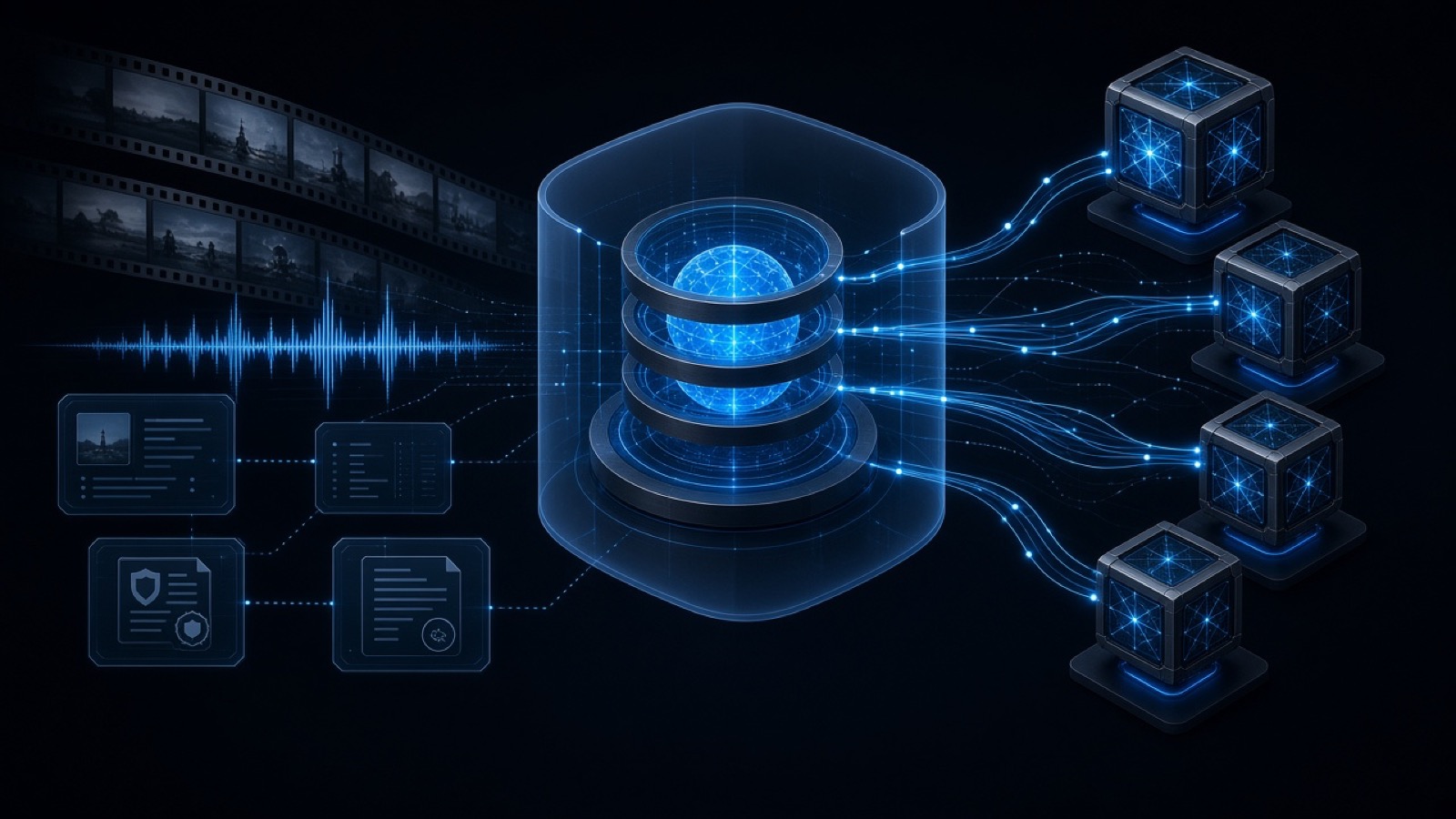
We want more than a selector. We are building toward an orchestration layer that works on your terms: which models do the work, what information they receive, and whether that information can be used for training, fine-tuning or product direction, for what purpose and under whose control.
The aim is to connect AI to media operations without making migration the price of using it, and without handing the operating knowledge of the business to whoever happens to sit behind the current endpoint.
Ask every provider, including Flomenco, to show you where those boundaries are, how they are enforced, and what you can take with you if you leave.
Put the questions to your own stack
See how Flo connects AI models to media discovery and workflows while keeping model choice separate from the work around it.