
Why Workflow Automation Was Only Step One
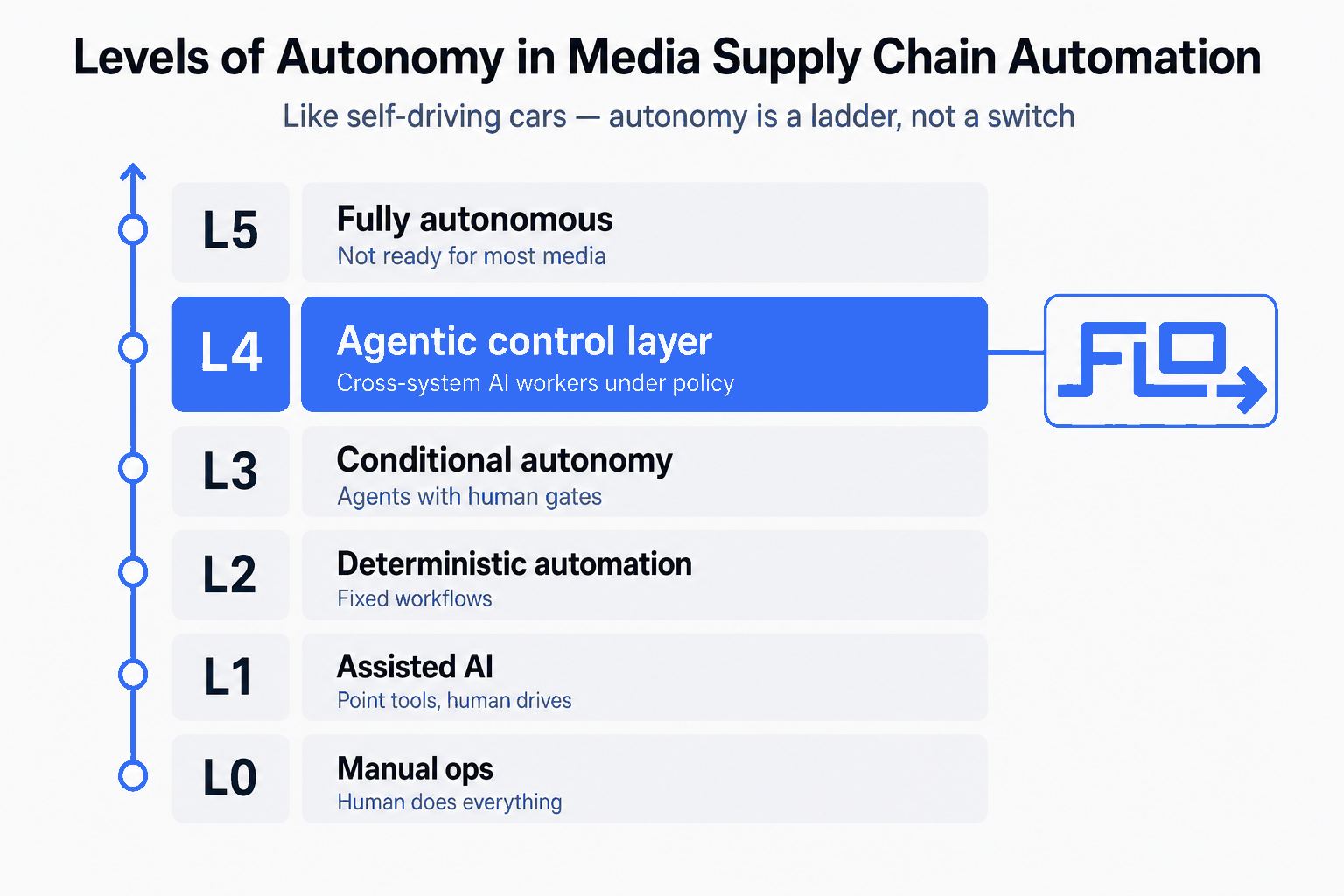
Media supply chain automation is leaving the era of fixed scripts and entering levels of autonomy—where AI workers handle the work between systems, humans set policy and judgment, and the winning architecture is an agentic control layer, not another repository.
AI will not replace your MAM. It will not replace your metadata system, rights database, or QC tool. It will replace the work between them: the Slack threads, spreadsheet trackers, “did this version get to partner X?” pings, and the human integration layer that still glues enterprise media stacks together.
Every media operation will eventually run more AI workers than human operators. That is not a threat narrative. It is an operating-model problem. The teams that win will treat autonomy like the auto industry treated self-driving: in levels—with clear control, clear handoffs, and no fantasy of unsupervised Level 5 for brand-critical work.
What is media supply chain automation now?
For years, media supply chain automation meant deterministic workflow platforms: if asset lands, then transcode, then QC, then deliver. That was real progress. It cut manual handoffs and made high-volume packaging possible.
Then AI showed up as point tools. Auto-tagging. Captions. Social reframes. Highlight reels. Content libraries got smarter labels and faster cutdowns—exactly the pattern outlined in industry pieces on AI in media assets (tagging, editing assistance, captions, enhancement). Useful. Incomplete.
Because tagging a file is not operating a supply chain. And a fixed workflow is not the same as managing agents that can reason across systems when the happy path breaks.
The market is now full of copilots, “agentic” product pages, and MCP hooks bolted onto existing platforms. Some of that is real. Some is agent washing. The useful question is not “Do we have AI?” It is: at what level of autonomy do we actually operate—and what level should we aim for next?
Levels of autonomy for the media supply chain
Borrow the self-driving mental model. Autonomy is not binary. It is a ladder—and most media companies are still between Level 1 and Level 2 while vendors market Level 4 language.
Level 0 — Manual ops
People move media by email, shared drives, and tribal knowledge. Tools exist, but the operator is the workflow.
Org impact: Heroic individuals. No audit trail. Scale breaks first.
Level 1 — Assisted AI (point tools)
AI helps a human do one task faster: generate metadata, captions, a vertical crop, a highlight pass. The human still drives every step and every handoff.
Where you see this: Standalone AI features and creative plugins. The baseline of AI inside asset work—useful for tagging, captions, reframes, and highlight passes.
Org impact: Individual productivity up. Process chaos unchanged. You still have the same number of systems—and the same glue work between them.
Level 2 — Deterministic automation
Rules and orchestrators execute known paths: ingest → validate → transform → package → deliver. Humans design the graph. The system runs the graph. Exceptions bounce back to people.
Where you see this: Classic media supply chain platforms and workflow engines. Strong on reliability for known routes. Weak when the work needs judgment, cross-system context, or novel exception handling.
Org impact: Ops can scale volume. Engineering owns the automation debt. Change cycles are slow because every new partner or policy means another rule rewrite.
Level 3 — Conditional autonomy
Agents (or agent-like services) handle scoped jobs—enrichment, localization prep, partner packaging variants—with human gates on risk. Deterministic steps still run where correctness must be exact. Agents propose; policy and approvers decide.
Where you see this: AI copilots that author or debug workflows; approval-gated AI actions; “trusted agentic” features inside channel or supply-chain suites.
Org impact: New roles emerge: exception owners, AI ops, policy owners. The bottleneck shifts from “who can click through the MAM” to “who can define guardrails.”
Level 4 — Agentic control layer (operating layer)
This is the top-right of the map: broad workflow scope and the ability to manage many AI workers across systems you already own.
An agentic media platform sits above storage, MAM, metadata, rights, and delivery endpoints. It does not ask you to rip out the stack. It replaces the human integration layer with governed agents and deterministic rails:
- Connect systems and context
- Discover the right media and metadata
- Generate or transform outputs
- Review with humans in the loop where stakes are high
- Deliver to the next destination with an audit trail
Org impact: Humans supervise goals, policy, and exceptions. AI workers outnumber operators for repetitive coordination. The control plane becomes a strategic asset—same idea as a control tower in logistics, applied to media.
Level 5 — Fully autonomous media ops
End-to-end operation with minimal human involvement. Interesting as a thought experiment. Dangerous as a near-term goal for most enterprises.
Org impact: Not the target for brand, rights, and compliance-heavy work. Aim for Level 4 with sharp Level 2/3 rails—not unsupervised Level 5.
The map vendors are actually competing on
Ignore the buzzwords for a minute. Plot the market on two axes:
- Workflow scope (X): point task → cross-system operating layer
- Agent management (Y): no agents → governed multi-agent control
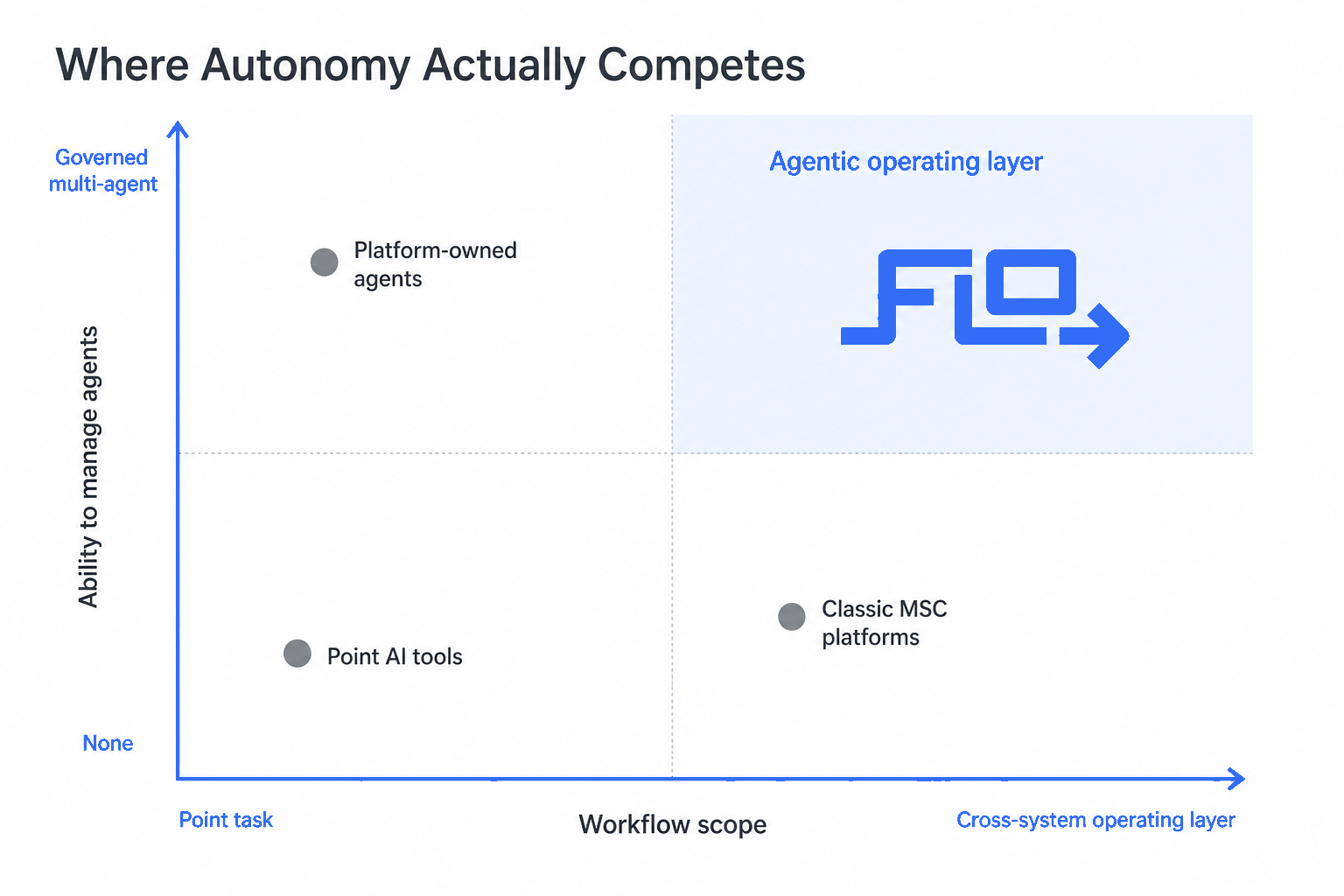
That gives you four useful zones:
| Zone | Pattern | What it feels like |
|---|---|---|
| Bottom-left | Point AI | Faster clicks, same chaos |
| Mid-X, low-Y | Deterministic orchestration | Reliable happy paths, slow change |
| High-Y, platform-owned | Agents inside one vendor suite | Autonomy—if you live in their world |
| Top-right | Agentic operating layer | Autonomy across your stack |
Bolt-on AI improves a product. An operating layer changes how the organization runs. That distinction matters more than feature checklists.
Also keep the second split clear: deterministic vs agentic.
- Deterministic for correctness: checksums, package specs, rights flags that must not “creatively interpret.”
- Agentic for judgment under policy: which cutdown, which metadata enrichment path, how to resolve an exception with incomplete context.
Not everything should be agentic. The best media operations will be hybrid by design.
What happens when you have more AI workers than operators
If the ratio flips, the org has to change—or the AI just creates faster mess.
Plan differently. Stop buying “another AI feature” as a side quest. Decide your target autonomy level by workflow family (ingest, localization, partner delivery, promo versioning). Most teams should push high-volume, low-judgment paths toward Level 2–3, and cross-system coordination toward Level 4.
Operate differently. Operators become conductors: monitor queues, resolve exceptions, tune policy. You need observability for agents the way you already need it for workflows—what ran, what it saw, what it changed, who approved.
Manage differently. Treat AI workers like a workforce with roles, permissions, and performance reviews—not magic. Version prompts and policies. Separate model choice from workflow ownership. Keep human-in-the-loop approval where brand, legal, or partner risk is asymmetric.
This is where Flo sits: as an agentic control layer—the connective tissue that makes Connect → Discover → Generate → Review → Deliver share context across the tools you already run.
Assess your autonomy level with Flo
See how Flo works as an agentic control layer across the systems you already run—without rip-and-replace.
Talk to FloWhy workflow automation was only Step One
Step One proved that media companies can remove human swivel-chair work when the path is known.
Step Two is harder: the path is not always known. Partners change specs. Metadata is incomplete. Rights are messy. Campaigns invent new formats weekly. Deterministic graphs alone cannot absorb that variance without becoming a second enterprise IT project.
So the industry is racing to agents. Some will ship copilots that write workflows faster (still Level 2 with better UX). Some will ship specialized agents inside a closed suite (high Y, limited X). The durable advantage is top-right: manage agents and workflows across systems, with governance strong enough that more AI workers does not mean more risk.
What the next year looks like—and how to prepare
Expect three things to intensify over the next twelve months:
- MCP and agent interfaces become table stakes for serious platforms—agents will expect to query status, trigger work, and read structured supply-chain definitions.
- Named agent catalogs proliferate (metadata, artwork, scheduling, localization, compliance). Buyers will confuse “we have agents” with “we can operate agents across our stack.”
- Governance becomes the buying criterion. After the first public failure of unsupervised publish, boards will ask about audit, approvals, and policy—not model demos.
Practical next steps
- Score your current level for five critical workflows. Be honest: most “AI transformations” are still Level 1 with a Level 2 island.
- Draw the between-systems map. List the handoffs humans still own between MAM, metadata, rights, storage, and delivery. That map is your Level 4 backlog.
- Split deterministic vs agentic on purpose. Write it down: which steps must be exact, which can reason under policy.
- Stand up an exception model before you scale agents. Who owns failures? What escalates? What is auto-retried?
- Pilot one cross-system workflow with measurable volume—not a lab demo. Prove Connect → action → Review → Deliver with an audit trail.
- Hire or appoint an AI ops owner for media—not a prompt hobbyist, someone accountable for workforce-of-agents performance.
- Refuse rip-and-replace theater. If a vendor needs you to abandon your MAM to get autonomy, you are buying a new silo with better marketing.
Frequently asked questions
Do we need to replace our MAM to get agentic automation?
No. The point of an operating layer is to automate work between systems you already trust. Repositories still matter for governance and storage; they are not the control plane for AI workers.
Is Level 4 the same as letting AI publish everything?
No. Level 4 means many AI workers coordinated under policy, with humans controlling goals, approvals, and exceptions. Unsupervised publish is a Level 5 fantasy for most brands.
Where does Flo fit on the levels?
Flo is built for the top-right: media supply chain automation as an agentic media platform—workflow scope across your stack, plus the ability to manage AI-assisted work with review and delivery controls. Explore Discover, Generate, and Deliver as the lifecycle, not as isolated tools.
The edgy take
The industry is arguing about models. The real fight is about control planes.
In five years, every serious media company will have a workforce of AI agents. The losers will have agents trapped inside five products that cannot see each other. The winners will have an agentic control layer that treats MAM, metadata, rights, and delivery as systems of record—and treats the work between them as the product.
Workflow automation was Step One. Managing autonomy is the job now.